Reliable F5CAB3 Source, Valid F5CAB3 Test Topics
Wiki Article
What's more, part of that Actual4test F5CAB3 dumps now are free: https://drive.google.com/open?id=19-V-2vJlxqrorMpLrsrdrhJlc1zz3EuI
Downloading the F5CAB3 free demo doesn't cost you anything and you will learn about the pattern of our practice exam and the accuracy of our F5CAB3 test answers. We constantly check the updating of F5CAB3 vce pdf to follow the current exam requirement and you will be allowed to free update your pdf files one-year. Don't hesitate to get help from our customer assisting.
There are different ways to achieve the same purpose, and it's determined by what way you choose. A lot of people want to pass F5 certification F5CAB3 exam to let their job and life improve, but people participated in the F5 Certification F5CAB3 Exam all knew that F5 certification F5CAB3 exam is not very simple. In order to pass F5 certification F5CAB3 exam some people spend a lot of valuable time and effort to prepare, but did not succeed.
Valid Reliable F5CAB3 Source Provide Prefect Assistance in F5CAB3 Preparation
If you fail, don't forget to learn your lesson. If you still prepare for your test yourself and fail again and again, it is time for you to choose a valid F5CAB3 study guide; this will be your best method for clearing exam and obtain a certification. Good F5CAB3 study guide will be a shortcut for you to well-directed prepare and practice efficiently, you will avoid do much useless efforts and do something interesting. Actual4test releases 100% pass-rate F5CAB3 Study Guide files which guarantee candidates 100% pass exam in the first attempt.
F5 BIG-IP Administration Data Plane Configuration Sample Questions (Q19-Q24):
NEW QUESTION # 19
Refer to the exhibit.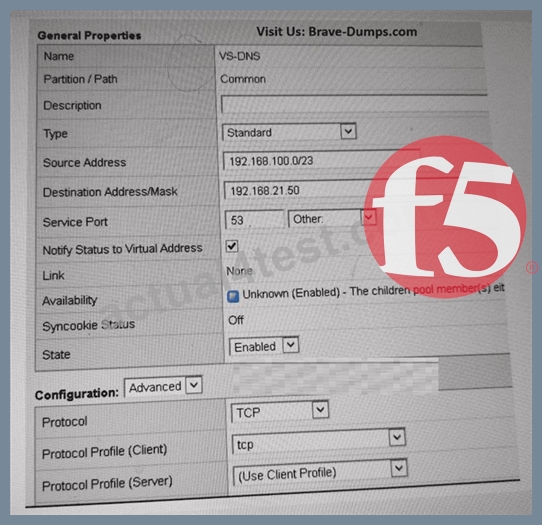
DNS queries from two internal DNS servers are being load-balanced to external DNS servers via a virtual server on a BIG-IP device. The DNS queries originate from:
192.168.10.100
192.168.10.200
and target:
192.168.2.150
All DNS queries destined for the external DNS servers fail.
Which property change should the BIG-IP Administrator make in the Virtual Server to resolve this issue? (Choose one answer)
- A. Source Address to 192.168.10.0/24
- B. Protocol profile (Client) to DNS_OPTIMIZED
- C. Protocol to UDP
- D. Type to Performance (HTTP)
Answer: C
Explanation:
DNS traffic is primarily transported using UDP port 53. In the exhibit, the Virtual Server is configured with the Protocol set to TCP, which prevents standard DNS queries from being processed correctly. BIG-IP Virtual Servers must be configured with the correct Layer 4 protocol to match the application traffic they are handling.
According to the BIG-IP Administration: Data Plane Configuration documentation:
The Protocol setting on a Virtual Server defines whether traffic is processed as TCP, UDP, or another supported transport protocol.
Standard DNS queries and responses use UDP, while TCP is only required for DNS zone transfers (AXFR) or exceptionally large responses.
When a DNS Virtual Server is incorrectly configured with TCP, UDP-based DNS queries are dropped, causing all requests to fail.
Why the other options are incorrect:
A . Protocol profile (Client) to DNS_OPTIMIZED
A DNS profile enhances DNS functionality but does not correct an incorrect transport protocol configuration.
B . Type to Performance (HTTP)
Performance (HTTP) Virtual Servers are designed for HTTP traffic and are not suitable for DNS services.
C . Source Address to 192.168.10.0/24
The existing source IPs already fall within the allowed range, so this setting does not address the failure.
Correct Resolution:
Changing the Protocol to UDP aligns the Virtual Server with standard DNS transport requirements, allowing DNS queries to be successfully processed and load-balanced.
NEW QUESTION # 20
An LTM device has a virtual server mapped to www.f5.com with a pool assigned. The objects are defined as follows: Virtual server: Destination 192.168.245.100:443 netmask 255.255.255.0. Persistence: Source address persistence netmask 255.0.0.0. SNAT: Automap. Profiles: HTTP/TCP. How should the BIG-IP Administrator modify the persistence profile so that each unique IP address creates a persistence record?
- A. netmask 0.0.0.0
- B. netmask 255.255.255.255
- C. netmask 255.255.0.0
- D. netmask 255.255.255.0
Answer: B
Explanation:
Source Address Affinity (Persistence) works by tracking the source IP address of incoming packets to ensure a client stays connected to the same backend server. The " netmask " setting within the persistence profile determines the " granularity " of this tracking. A netmask tells the BIG-IP how many bits of the source IP address to ignore when creating the persistence record. For example, the current setting of 255.0.0.0 (a /8 mask) means the BIG-IP only looks at the first octet of the IP; this results in all users from the same large Class A network (e.g., everyone from 10.0.0.0 to 10.255.255.255) being persisted to the exact same server, which can lead to severe load imbalance.
To ensure that each unique IP address creates its own individual persistence record, the administrator must set the netmask to 255.255.255.255 (for IPv4). This is a " host mask " or /32, which instructs the BIG-IP to evaluate all 32 bits of the client ' s source IP address. With this setting, 10.1.1.1 and 10.1.1.2 will be treated as distinct entities and can be load balanced to different servers, each maintaining their own " stickiness " .
While Option A (255.255.255.0) would group users by their local subnet, only the full 255.255.255.255 mask satisfies the requirement for true unique-IP persistence. This configuration is standard for internet-facing applications where users arrive from diverse locations and the administrator wants to maintain the most granular and balanced distribution of traffic possible.
NEW QUESTION # 21
For a given Virtual Server, the BIG-IP must perform SSL Offload and negotiate secure communication over TLSv1.2 only. What should the BIG-IP Administrator do to meet this requirement?
- A. Configure a custom SSL Profile (Server) with a custom TLSv1.2 cipher string
- B. Configure a custom SSL Profile (Server) and select no TLSv1 in the options list
- C. Configure a custom SSL Profile (Client) and select no TLSv1 in the options list
- D. Configure a custom SSL Profile (Client) with a custom TLSv1.2 cipher string
Answer: D
Explanation:
To fulfill the requirement of "SSL Offload" limited to "TLSv1.2 only," the administrator must focus on the client-side of the connection. SSL Offload means the BIG-IP terminates the encrypted connection from the user, processes the traffic (often as plain text internally), and optionally sends it to the backend. The profile responsible for this termination and the initial negotiation with the client's browser is the Client SSL Profile.
A custom Client SSL Profile must be created because the default clientssl profile typically allows a broad range of protocols for compatibility (including TLS 1.0, 1.1, and 1.2). To restrict communication specifically to TLS 1.2, the administrator modifies the Ciphers string within the profile. Using a string such as DEFAULT:!SSLv3:!TLSv1:!TLSv1.1 or specifically defining TLSv1.2-only suites ensures that the BIG-IP will reject any handshake attempts from older, less secure protocols.
Server SSL Profiles (Options B and C) are used for the encryption between the BIG-IP and the backend nodes, which is not what is requested here. Simply selecting "no TLSv1" in an options list (Option D) is insufficient and often refers to older versions of the software; the modern and standard way to control protocol negotiation on a BIG-IP is through the precise application of Cipher Strings within the Client SSL profile. This ensures compliance with security standards like PCI-DSS while providing the offloading benefits to the backend infrastructure.
NEW QUESTION # 22
The BIG-IP Administrator has to provide encrypted communication between users and the virtual server they access. Multiple hostnames are configured in DNS with the same IP address.
Which profile type and setting in the profile should be used? (Choose one answer)
- A. Client SSL, Client Name
- B. Client SSL, Server Name
- C. Server SSL, Server Name
- D. Server SSL, Client Name
Answer: B
Explanation:
When multiple hostnames resolve to the same IP address and encrypted communication is required, the BIG- IP must be able to present the correct SSL certificate based on the hostname requested by the client. This is accomplished using Server Name Indication (SNI).
According to BIG-IP Administration: Data Plane Configuration documentation:
* SNI is a client-side TLS extension, where the client includes the requested hostname during the SSL handshake.
* BIG-IP evaluates this hostname using the Client SSL profile, not the Server SSL profile.
* The "Server Name" setting in the Client SSL profile enables BIG-IP to select the appropriate SSL certificate for the requested hostname.
Why option C is correct:
* Client SSL profile handles inbound (client-side) encryption.
* Server Name enables SNI-based certificate selection when multiple DNS names share the same virtual server IP.
Why the other options are incorrect:
* A. Client SSL, Client NameThere is no Client SSL setting called Client Name for SNI certificate selection.
* B. Server SSL, Server NameServer SSL is used for encryption between BIG-IP and backend servers, not for client-side hostname identification.
* D. Server SSL, Client NameServer SSL does not process client-requested hostnames during TLS negotiation.
Correct Resolution:
Configure a Client SSL profile and enable the Server Name (SNI) setting to support multiple encrypted hostnames on the same virtual server IP.
NEW QUESTION # 23
A BIG-IP Administrator configures an SSH pool with five members.
Which health monitor should be applied?
- A. UDP
- B. HTTPS
- C. HTTP
- D. TCP
Answer: D
Explanation:
SSH is a TCP-based service. A TCP monitor validates service availability without requiring application-layer inspection.
NEW QUESTION # 24
......
One of features of us is that we are pass guaranteed and money back guaranteed if you fail to copyright after buying F5CAB3 training materials of us. Or if you have other exam to attend, we can replace other 2 valid exam dumps to you, at the same time, you can get the update version for F5CAB3 Training Materials. Besides, we offer you free update for 365 days after purchasing, and the update version will be sent to your email address automatically. The F5CAB3 exam dumps include both the questions and answers, and it will help you to practice.
Valid F5CAB3 Test Topics: https://www.actual4test.com/F5CAB3_examcollection.html
The Valid F5CAB3 Test Topics - BIG-IP Administration Data Plane Configuration certification you achieve will help demonstrate your knowledge and competency in maintaining the issue in related professional field, Our study materials allow users to use the F5CAB3 certification guide for free to help users better understand our products better, Actual4test is aware that preparing with invalid F5 F5CAB3 Exam Questions wastes money and time.
Because an immutable object cannot be changed, F5CAB3 all data must be declared `private`, Associate the Actors and Use Cases, The BIG-IP Administration Data Plane Configurationcertification you achieve will help demonstrate Reliable F5CAB3 Source your knowledge and competency in maintaining the issue in related professional field.
Get Help from Real and Experts Verified Actual4test F5 F5CAB3 Exam Dumps
Our study materials allow users to use the F5CAB3 Certification guide for free to help users better understand our products better, Actual4test is aware that preparing with invalid F5 F5CAB3 Exam Questions wastes money and time.
F5CAB3 Pass4sures training torrent empowers the candidates to master their desired technologies for their own F5CAB3 exam test, All F5CAB3 study materials you should know are written in them with three versions to choose from.
- Real F5CAB3 Dumps Free ???? F5CAB3 Test Result ???? New F5CAB3 Test Pdf ⭕ Go to website ⇛ www.dumpsquestion.com ⇚ open and search for ☀ F5CAB3 ️☀️ to download for free ????Valid F5CAB3 Practice Materials
- Pass Guaranteed Quiz F5 - Pass-Sure Reliable F5CAB3 Source ???? Download 【 F5CAB3 】 for free by simply entering ( www.pdfvce.com ) website ↙Real F5CAB3 Dumps Free
- F5CAB3 Test Result ???? Test F5CAB3 Answers ???? Reliable F5CAB3 Dumps Free ???? Search on “ www.pdfdumps.com ” for ▷ F5CAB3 ◁ to obtain exam materials for free download ????New F5CAB3 Test Discount
- Enhance Your Success Rate with Pdfvce's F5CAB3 Exam Dumps ???? Open 《 www.pdfvce.com 》 and search for ➥ F5CAB3 ???? to download exam materials for free ????Downloadable F5CAB3 PDF
- Test F5CAB3 Simulator ???? F5CAB3 Test Result ???? Downloadable F5CAB3 PDF ???? Search on ⮆ www.prepawaypdf.com ⮄ for ➽ F5CAB3 ???? to obtain exam materials for free download ????F5CAB3 Valid Practice Materials
- Enhance Your Success Rate with Pdfvce's F5CAB3 Exam Dumps ???? Open ▶ www.pdfvce.com ◀ enter ⇛ F5CAB3 ⇚ and obtain a free download ????Reliable F5CAB3 Dumps Free
- Test F5CAB3 Objectives Pdf ↔ F5CAB3 Test Result ???? New F5CAB3 Exam Format ???? Immediately open ⏩ www.practicevce.com ⏪ and search for 【 F5CAB3 】 to obtain a free download ????New F5CAB3 Test Pdf
- BIG-IP Administration Data Plane Configuration Test Questions and Answers are Easy to Understand - Pdfvce ???? Search for ( F5CAB3 ) and obtain a free download on 《 www.pdfvce.com 》 ????New F5CAB3 Test Pdf
- Free PDF Quiz 2026 F5 Updated Reliable F5CAB3 Source ???? Simply search for “ F5CAB3 ” for free download on 《 www.prepawaypdf.com 》 ????Valid F5CAB3 Practice Materials
- 2026 High Pass-Rate Reliable F5CAB3 Source | F5CAB3 100% Free Valid Test Topics ???? Open ☀ www.pdfvce.com ️☀️ enter { F5CAB3 } and obtain a free download ????F5CAB3 Paper
- Test F5CAB3 Simulator ???? F5CAB3 Paper ???? New F5CAB3 Exam Review ???? Download ⏩ F5CAB3 ⏪ for free by simply searching on ➡ www.easy4engine.com ️⬅️ ????F5CAB3 Test Result
- myportal.utt.edu.tt, myportal.utt.edu.tt, myportal.utt.edu.tt, myportal.utt.edu.tt, myportal.utt.edu.tt, myportal.utt.edu.tt, myportal.utt.edu.tt, myportal.utt.edu.tt, myportal.utt.edu.tt, myportal.utt.edu.tt, anitaqtqz816591.estate-blog.com, myportal.utt.edu.tt, myportal.utt.edu.tt, myportal.utt.edu.tt, myportal.utt.edu.tt, myportal.utt.edu.tt, myportal.utt.edu.tt, myportal.utt.edu.tt, myportal.utt.edu.tt, myportal.utt.edu.tt, myportal.utt.edu.tt, phoenixdhdv129963.cosmicwiki.com, honeysnof114063.csublogs.com, nikolasbwwn522266.ourabilitywiki.com, tiffanyfagi110870.csublogs.com, bookmarketmaven.com, 210list.com, harmonycpin557216.wikibestproducts.com, Disposable vapes
P.S. Free & New F5CAB3 dumps are available on Google Drive shared by Actual4test: https://drive.google.com/open?id=19-V-2vJlxqrorMpLrsrdrhJlc1zz3EuI
Report this wiki page